
Before traveling to Vienna, you should know the differences between the Upper and Lower Belvedere. Below, we detail the key aspects of both museums to help you decide which one to choose.
Upper or Lower Belvedere
Before “pitting” the Upper VS Lower Belvedere against each other, you need to understand that the main difference between the two museums lies in the collection each houses, an aspect you probably value most if you are an art lover.
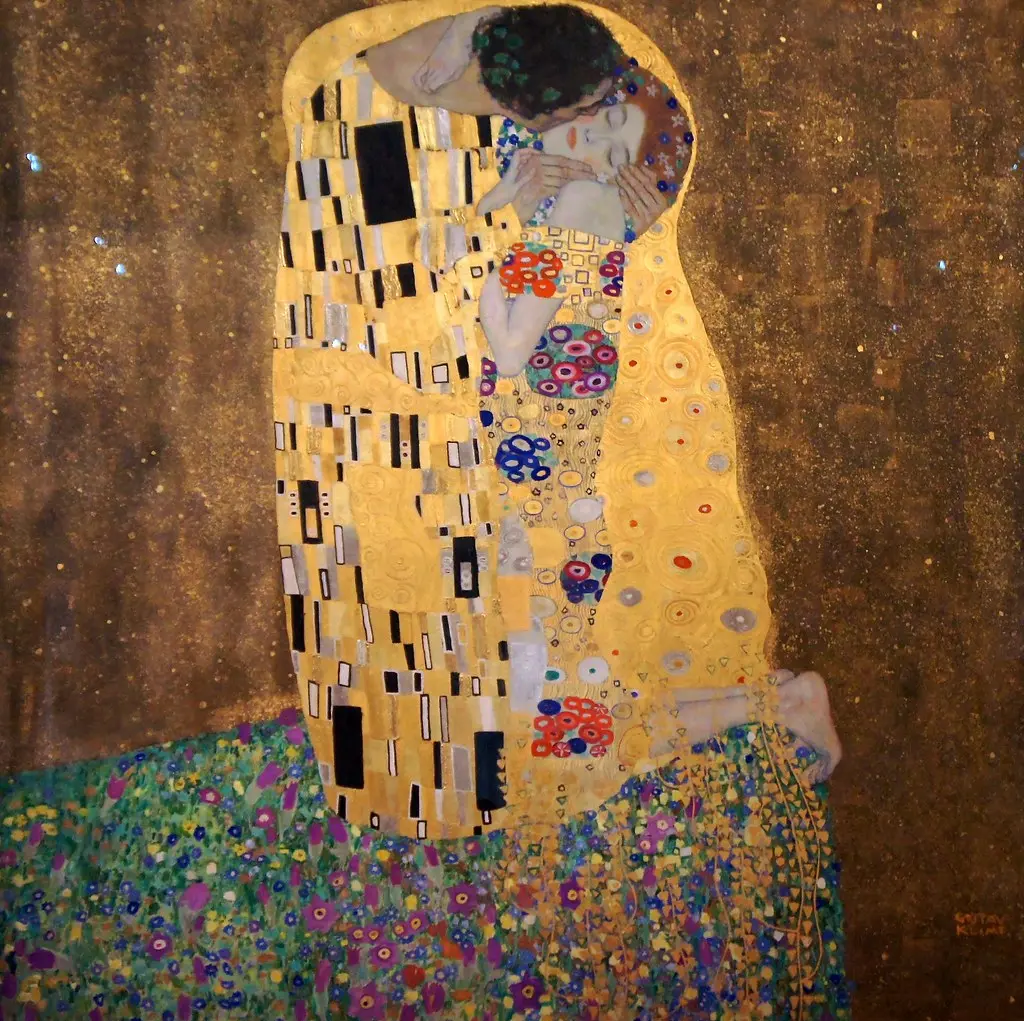
The Upper Belvedere holds the most important permanent art collection, highlighting, above all, Viennese Modernism, with iconic works like The Kiss by Gustav Klimt. In contrast, the Lower Belvedere focuses more on hosting temporary exhibitions and showcasing the opulence of the palace’s former residential rooms.
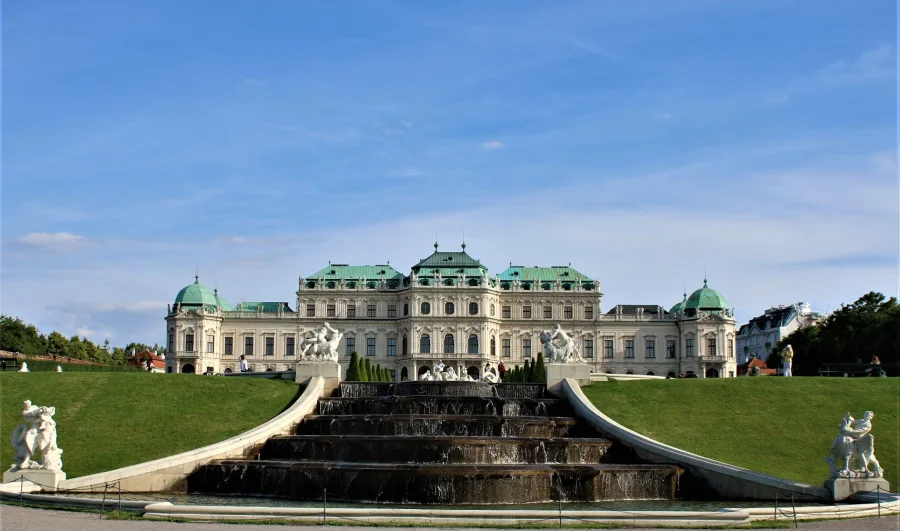
To understand this better, let’s go back to the history of both buildings. The Belvedere Palace is actually a complex of two Baroque palaces, designed by Johann Lukas von Hildebrandt for Prince Eugene of Savoy. Prince Eugene used the palace as his summer residence.
The Upper Belvedere, located on the higher part of the gardens, was primarily used for ceremonial and representative functions, while the Lower Belvedere, situated on the lower grounds, was his residential palace. So, in essence, one was for “showing off” and the other for living.
Today, that historical distinction is reflected in its use as a museum. The Upper Belvedere is the most famous and crowded, thanks to its impressive permanent collection. Inside, you will find the Marble Hall, a spectacular space, in addition to the rooms dedicated to the art collection, which spans from the Middle Ages to the 20th century, with the highlight, of course, being the room dedicated to Klimt.
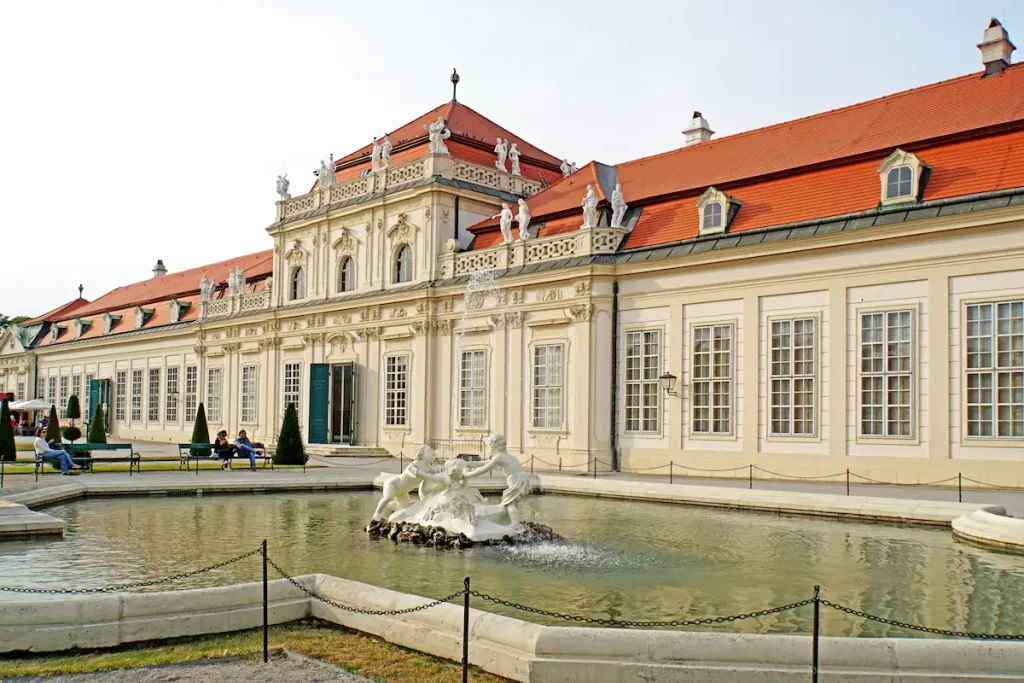
The Lower Belvedere, for its part, although it doesn’t have the most famous permanent collection, is a treasure in itself. By visiting it, you can get an idea of what life was like in a Baroque palace, touring historic spaces like the Marble Gallery, the Hall of the Grotesque, or the Golden Room. Furthermore, there are spaces dedicated to art exhibitions, which gives it a much more dynamic and ever-changing focus.
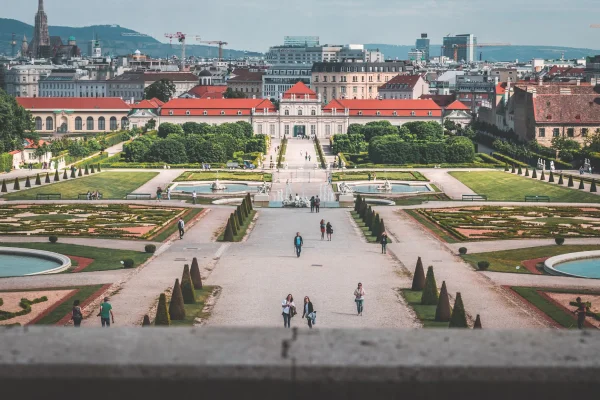
Both are connected by magnificent Baroque gardens (which we will talk about later), which are perfect for a stroll and are located in Vienna’s 3rd district, Landstraße. The Upper Belvedere is at Prinz-Eugen-Straße 27, and the Lower Belvedere is at Rennweg 6.
To see everything at a glance, we have prepared this comparative table between Upper VS Lower Belvedere:
| Feature | Upper Belvedere | Lower Belvedere |
|---|---|---|
| Primary Focus | Permanent art collection (Viennese Modernism, including The Kiss by Klimt) | Temporary exhibitions and historical interiors |
| Historical Function | Ceremonial residence | Residential palace for Prince Eugene |
| Key Spaces | Marble Hall and permanent art rooms | Marble Gallery, Hall of the Grotesque, Golden Room |
| Location | Higher part of the gardens | Lower part of the gardens (includes the Orangery and Palace Stables) |
The short answer is: yes. Especially if you have enough time. In that case, our recommendation would be to visit both spaces, although we understand that time might be limited during your trip.
If your main interest is seeing masterpieces, especially the famous Gustav Klimt’s “The Kiss“, then the Upper Belvedere is a must-see and should be your priority during your visit to Vienna. Its permanent collection is world-class and will not disappoint you.
On the other hand, the Lower Belvedere offers you a different experience. As we mentioned earlier, it focuses on temporary exhibitions. This means that its appeal constantly changes, which is a plus if you like variety or if you’ve been before. Therefore, it is worthwhile to check their website before going to see which temporary exhibition is scheduled, just to make sure the topic genuinely interests you. Besides, the historical rooms in the Lower are fascinating and allow you to connect with the palace’s history in a different way, which translates into a perfect complement to the Upper. It is not just about art, but about architecture and the history of palace life.
Yes, you need a ticket for the Upper and Lower Belvedere, as both are independent museums and, therefore, require an admission ticket to visit the interiors. It is important to know that tickets are sold separately for each, or you can also buy a combined ticket that grants you entry to both (which often ends up being more economical).
The good news is that the splendid outer garden that connects the Upper and Lower Belvedere is completely free to walk through. You can enter and exit the gardens whenever you want, at no cost!
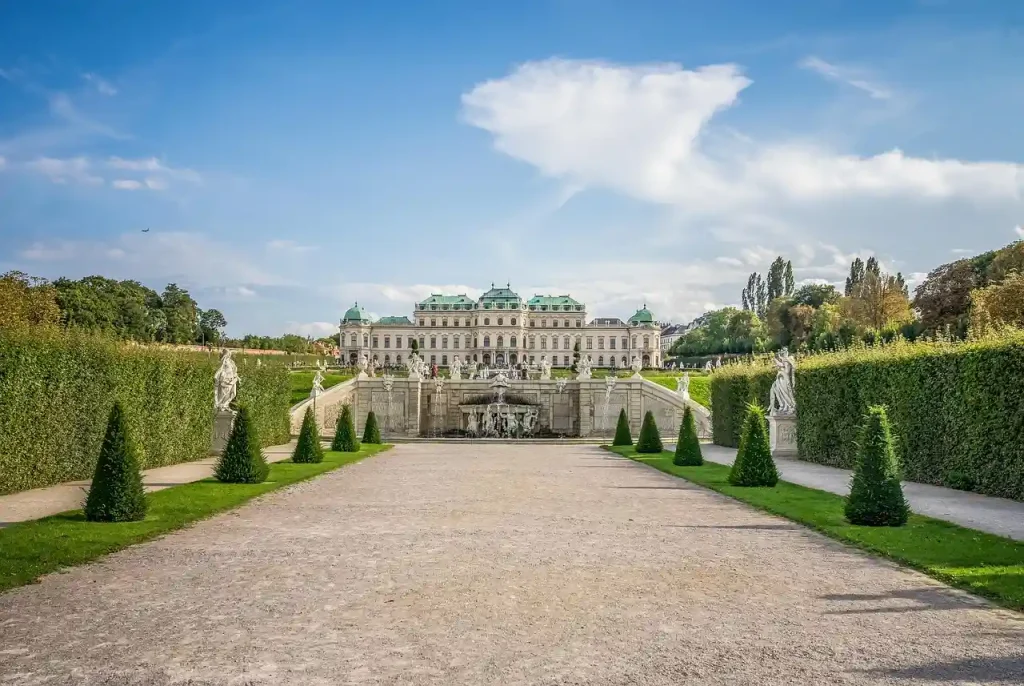
These gardens are a Baroque work of art with fountains, ponds, symmetrical flowerbeds, and statues. In fact, many people visit them just to enjoy the views and the tranquility they offer. You can take spectacular photos of the palaces and the view that opens up towards the city of Vienna. Ultimately, it is another great way to enjoy the complex without having to pay the entrance fee. Sounds pretty good, right?
The truth is that the time you spend on the visit will depend on your pace and how long you stop to admire each work, but these would be approximate estimates so you can plan your visit:
For the Upper Belvedere, most people spend between 1.5 and 2.5 hours. It is a large building and there is a lot of high-quality art to see, so our recommendation is to go with enough time and not rush.
As for the Lower Belvedere, the visiting time is usually a bit shorter, around 1 to 1.5 hours. Everything will depend on the time you dedicate to enjoying the Orangery and Palace Stables, where the exhibitions take place.
Also, you should not forget that you also have the possibility of walking through the gardens for free. This stroll could take you about 20 or 30 minutes.
Therefore, if you decide to visit both and enjoy a walk through the gardens, your visit to the Upper and Lower Belvedere could easily take you a full morning or afternoon, meaning 3 to 4 hours in total. Make your plans and enjoy yourself calmly!
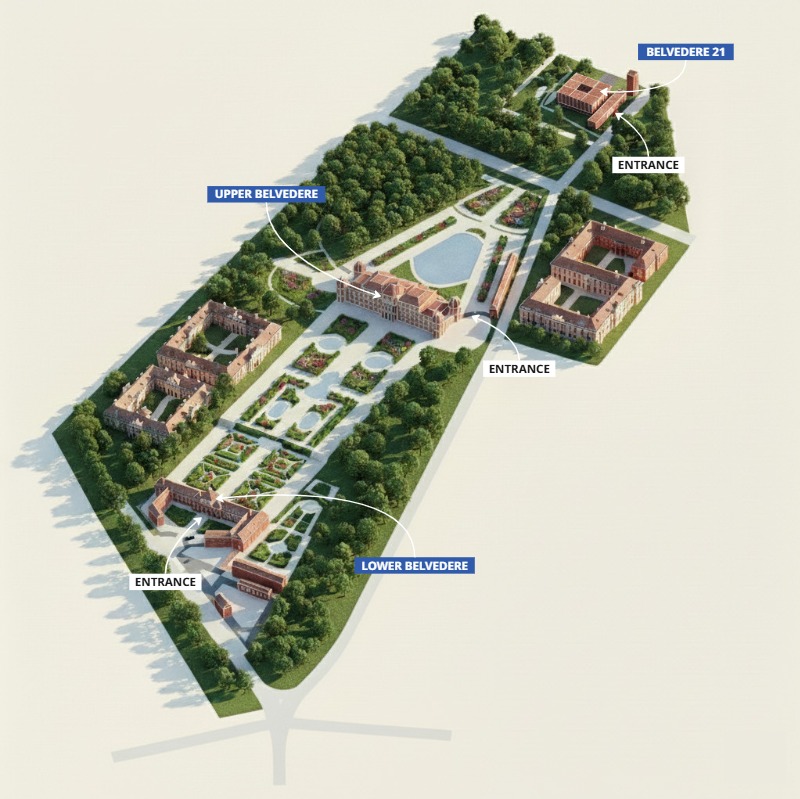
On this map, you can see the distance between the two buildings:
The opening hours for the Upper Belvedere are usually 9:00 AM to 6:00 PM, while the Lower Belvedere opens a little later, from 10:00 AM to 6:00 PM. These hours tend to be quite stable, but it is always a good idea to confirm them on the official website, especially if you are traveling during the low season or on public holidays:
| Location | Days Open | Regular Hours | Last Admission |
|---|---|---|---|
| Upper Belvedere | Monday – Sunday | 09:00 – 18:00 | 17:30 |
| Lower Belvedere | Monday – Sunday | 10:00 – 18:00 | 17:30 |
| Belvedere 21 | Tuesday – Sunday | 11:00 – 18:00 | 17:30 |
| Belvedere 21 | Thursday (Late Night) | 11:00 – 21:00 | 20:30 |
| Belvedere 21 | Monday | Closed* | N/A |
One important thing you should consider is the “Last Admission Policy.” In most museums, and the Belvedere is no exception, entry is allowed up until a certain time before closing, which is usually about 30 minutes. This means that if they close at 6:00 PM, you should make sure to enter before 5:30 PM to have time to access and do the tour.
Therefore, our recommendation is to enter at least an hour and a half before closing, so you can enjoy the visit without the stress of being hurried out. If you arrive too late, you won’t have time to fully appreciate the works of art or the historical interiors with the calmness they deserve. Don’t forget that!
BELVEDERE PALACE TICKETS

TRAVELER INFORMATION
BELVEDERE PALACE INFORMATION


